

I’ve seen very annoying notes these days making fun of people saying you can’t prove a negative. So here’s my hot take.
You cannot prove a negative that is not:
Tautological (You can prove a triangle doesn’t have 4 sides)
Relying on direct perception/observation (You can prove there isn’t a planet between Earth and Mars)
Based on systems of knowledge that produce clear answers (You can prove that Kamala Harris is not the 47th president of the United States, or that China is not in the western hemisphere).
But all of these methods of proving a negative are trivial.
What we care about when it comes to evaluating the truth of theories or conclusions are those that operate under outlier levels of uncertainty: Where the logic is unclear and where we lack direct perception of the relevant data points.
A Non-Religious Example:
Eventually, we’re going to get to the philosophy of religion, but let’s stick to current events. Can you prove with certainty that Hillary Clinton did not go to Epstein island?
Most people would agree that the fact that we don’t have any evidence that HRC even knew or interacted with Jeffrey Epstein is good grounds to conclude she never went to the island. But that’s not proving a negative, that’s apportioning beliefs to evidence!
If we were to prove the negative that she didn’t go to the island, we would have to account for every movement of her life. Or, when someone claims she was on the island, establish a credible alibi for her that time.
Let’s call the first instance the difficult case, and the second the easy case. The problem with the difficult case is that it is logically possible yet practically infeasible to account for someone’s movements for their entire life, especially an older person who preceded modern surveillance technology.
The problem with the easy case is that it only works for single instances, and accusers are welcome to fabricate new allegations. We may have disproven that HRC was not on the island at time A, but we can allege that she was there at time B,C, and D. We can just make up allegations! They let you do that when you’re famous!
So again, it is logically possible to prove a negative in many circumstances. We can prove negative trivial points, where the information landscape is fully accounted for, like a logical proof or direct perception. But when it comes to controversial points about religion, politics, science, crime, and others, we lack the full information landscape and so we usually cannot prove a negative.
And so, we cannot prove that HRC didn’t go to Epstein island because we lack full access to her entire life’s movements. We also cannot prove that a rogue planet didn’t come through our solar system at specific point in our deep history. We also cannot prove that Napoleon didn’t have breakfast on the day before his 25th birthday. And so on.
Why Do People Say You Can’t Prove A Negative?
There are many reasons people say we can’t prove a negative. I get accused of being Orwellian for defending these people, but there’s clear utility in not normalizing this standard of evidence to justify disbelieving a proposition, hypothesis, or theory.
I call this the “show trial” standard of evidence: Anyone can believe what they want, so long as their theories aren’t explicitly contradicted by specific points of evidence. I call it a show trial because show trials are not guided by what is true. In this way, when we refuse to rule out some hypotheses and theories merely because they are logically possible, we pollute our ability to discern truth, allowing non-truth oriented considerations to guide our conclusions.
If you really hate Hillary Clinton, you can come up with all sorts of reasons to believe she was on Epstein island eating children or whatever. And if we put the burden of proof on her to debunk every logically possible theory of her being there, you’re giving her an impossible standard of defense. She will lose because she can’t prove every negative.
As a filtering mechanism, we should reject unfalsifiable explanations and explanations that hinge on one’s inability to prove a negative in an environment of uncertain information. That way, we can align ourselves to believe and affirm ideas that are evidenced, advancing shared standards of truth and probability.
This norm is as much social as it is intellectual. I personally don’t care if you believe in unfalsifiable theories or if your theories about how the world works hinges on my inability to prove a negative about something. What I care about is when we normalize this “show trial” standard of evidence in public, political, or philosophical discourse. It leads us to discard reason in favor of intellectual and social witch hunts.
Two Atheisms
But wait, this is a blog about religion!
The apex of the “you can’t prove a negative” slogan is in the philosophy of religion discourse, namely among atheists.
For our purposes, there are two kinds of atheists: Those that believe we cannot prove negatives about non-trivial matters, and those that believe we can.
We’re going to call the first group lacktheists. Many atheists will concede that they can’t prove God doesn’t exist, but because we can’t do that about a lot of things we disbelieve, we’re still justified in atheism. I don’t have time to verify this, but I’m pretty sure this viewpoint was popularized by Richard Dawkins in The God Delusion, when he argued that the burden of proof for theism is on theists.
We’re going to call the second group the anti-theists. This school of thought was popularized by Victor Stenger in his book God: The Failed Hypothesis. It’s Stenger and the anti-theist position that you can, indeed, prove a negative when it comes to God. For them, God is a scientific hypothesis that can be falsified or negated. To do this, you simply take God’s purported characteristics, model them in a hypothetical universe, and see if that universe is compatible with the one we observe.
For the anti-theist, we can rely on knowledge and inference produced by the scientific method with a similar degree of certainty as our sense perception. Just as I can affirm that there isn’t a pink elephant in the room as I’m typing this, as I do not perceive one, the anti-theist affirms that there is no God in the universe. This, because God is not causally discernable in scientific models, and in fact contradicts observations of the universe.
Putting my cards on the table: I think both of these positions are defensible and compatible with one another. They both bring you to the same place: moral certainty about how you should live your life, conditional on God’s nonexistence. Lacktheists and anti-theists are not going to live their lives radically different from each other, and it’s fair to just classify either as mere atheists.
Why This Slogan Became Popular
A few weeks ago, before something in my personal life derailed my ability to focus on writing, I was trying to write this post in response to a podcast Alex O’Connor and Joe Schmid made where they debunked atheist slogans. What was frustrating about that podcast was the pure contempt and condescension Schmid expressed on this point, basically implying anyone who believes it is an idiot. What he missed was the key social context and nuance of the slogan, which I’ll get into here.
In the 2000s and 2010s, New Atheism was popular, and more people left religion for philosophical reasons. This was disheartening to many Christians, many of whom had this preening, demanding approach when dealing with non-Christians (and still do today). They typically lacked the philosophical education to have a respectful or productive conversation on why people disbelieve Christianity.
Most convinced atheists born in the 1990s or before have had a frustrating interaction with a Christian about their lack of belief. Usually, the Christian would want to have the conversation (in my experience, normie atheists don’t like these conversations unless they’re talking to a fellow non-believer because usually these disagreements end in Christians cutting the atheists out of their lives), and would be thoroughly unprepared.
The atheist would have good arguments about why evolution is true, why they don’t trust religious testimony for miracles, or how religious arguments are unsatisfactory, or any other arguments, and the theist just couldn’t keep up. The Christian final move would always be (something like) leaning back in their seat, folding their arms, spreading an eat-shit grin and saying “Well, you can’t prove God doesn’t exist” and a subsequent comment for why that’s bad (you’re overconfident, your position is unsupportable, etc).
Any atheist who has had these conversations has had this experience. It’s extremely frustrating, and fuels many of the annoying cringe online atheism.1 The Dawkins slogan became popular as a means to shift the conversation. If the theist is going to at least pretend to argue with you, they have to have an argument, use reasoning, and tell us affirmatively why they believe in God or why the atheist counterarguments aren’t effective. Some Christians can do this! But most of them cannot.
The Dawkins-Stenger Dilemma
Anyway, the Schmid/O’Connor conversation was frustrating because it once again fits into the META of philosophy or religion on social media, which I have written about before.
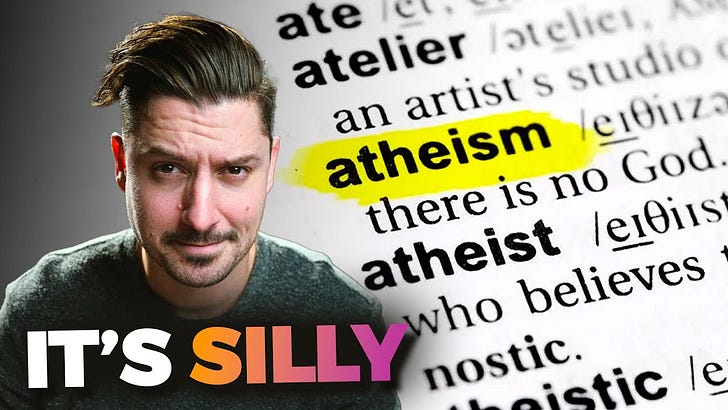
It’s normal to say mean things about atheists and hold them to different standards than Christian Apologists. I’m waiting for the philosophy centrists on YouTube to release a podcast debunking Christian slogans. The reason why they don’t is because it would last a few days, not a few hours!
I’m standing my ground on (not) proving negatives because I think there’s a social agenda that comes with calling people idiots who disagree on this narrow point, making atheists feel as if they must be combative or overconfident to be intellectually consistent.
Though the apologists may score some YouTube monetization points for these kinds of dunks, I don’t think in their heart of hearts they’d prefer atheists to be anti-theistic instead of lacktheistic.2
In my experience, your typical atheist can be a lacktheist or anti-theist pending on how he or she is feeling. If you put a gun to their head, they’d probably say “I’m pretty sure that God (Christian or otherwise) isn’t real and I live my life as if He weren’t, but because I lack the perceptual faculties to falsify God, I can’t disprove God with 100 percent certainty.”
And so, the “normie” atheist is presented with what I call the Dawkins-Stenger Dilemma:
Should they stridently declare that God has been falsified and act accordingly, being combative, dismissive and patronizing to religious people because religion is demonstrably false? (The Stenger Approach)
Or should they proclaim that they can’t prove a negative, disbelieve in God because they lack evidence, and be more humble and accommodating in interactions with theists? (The Dawkins Approach - I know that’s not how Dawkins himself acts, but it’s all relative!)
This dilemma is not an intellectual dilemma, but a social one. Most atheists I know side with Dawkins over Stenger because they don’t want to be a dick to Christians, and it takes a lot of work to be on Stenger’s level of knowledge and confidence.
When an atheist says “You can’t prove a negative,” he’s often trying to tell you that he’s pretty sure your religious beliefs are wrong, but he recognizes that’s a dick thing to do, so he’s opted to not continue the conversation. He’s also saying that he is fallible and humble and not prepared to rule out your entire worldview, as he could be wrong, and not having the humility to admit fallibility is also a dick thing to do.
To reiterate: I think most atheists agree with both Stenger and Dawkins, it’s just easier to live life with minimal conflict using the Dawkins approach. When I see memes about not proving a negative being silly and that people who say it are dumb, what I really want to respond with is “Oh, so you don’t want atheists to be nice anymore? You want every philosophical conversation to be a show trial now? Fine!”
If atheists stopped taking the Dawkins route, there’d probably be a new atheist reawakening. And it would be worse than the first one, more akin to France’s laïcité, which is more radical than the secularism you see in the Anglo-American world.
Closing Points
As I’ve said before, I am accused of being Orwellian for saying “actually this wrong thing is true,” so I want to close here with clear points about what I have argued:
Dunking on atheists about proving negatives is just pedantry. The negatives we can prove are typically trivial. The controversial things we argue about are very hard to negate.
We probably don’t want to live in an intellectual world where the standard of discarding a theory or hypothesis is merely falsification.
Both lacktheism and anti-theism are intellectually defensible and compatible with one another.
For atheists, there is social and psychological value in embracing lacktheism, even if you suspect anti-theism is true.
Anti-theism is technically more dogmatic than lacktheism because it holds to a firmer conviction on one philosophical point. Many atheists are reluctant to bite this bullet not because they don’t think it’s true, but because they sincerely believe that holding to dogmas unnecessarily leads to conflict.
Christians trying to stigmatize, dunk on, or name call atheists into being anti-theists should probably reconsider this strategy. Some may erroneously believe that stigmatizing lacktheism will push some atheists back to Christianity or theism. In reality, it’s more likely to breed another generation of confrontational antitheists/New Atheists.
So can we prove negatives? Sometimes. But not for the things that matter.
We definitely shouldn’t conduct philosophy via sloganeering, but we should also take care to not conduct philosophy by refuting slogans.
If you’re ever curious why shows like the atheist experience are popular or why not-100-percent-correct atheist slogans get thrown around a lot, experiences like this are why. I think it’s a universal experience of non-believers when they deconvert that believers refuse to acknowledge the validity of their perspective, recycling bad arguments at best, or retreating to this non-argument space that basically calls them a moron at worst. Atheist content on social media is satisfying for atheists because it says “hey you’re not a moron.” Long story short, we wouldn’t have annoying, argumentative atheists if most theists didn’t think disbelief was an intellectual vice.
Obviously, they’d prefer them to be Christian, but it seems to me like they’d rather just bully them out of any position instead of engaging them in good faith argument, unfortunately.
“You can prove a negative” plus “God works in mysterious ways” is an absolutely impenetrable argument if you grant both premises
Good post! I think I pretty much agree with the practical implications of what you say. But I'm pedantic enough that I want to object to the idea that proving a negative is particularly problematic in general; if you can't prove a negative, then you also can't prove a positive (generally).
If we hold a very strict standard for what counts as "proof," then the three kinds of negatives that can be proven are plausibly the only ones--but tautologies, perception, and systems of clear answers would then also be the only places where you can reliably prove a positive.
For example, with Napoleons breakfast, what would it look like to prove that he did? Probably some source saying "Truly, Napoleon broke his fast on the 25th anniversary of his birth" or something like that. But if that is enough to prove that he did, a similar source saying that he didn't have breakfast would also do the trick. If you can't prove the one, you can't prove either.
More generally, it seems to me that there isn't any deep difference between "negative" and "positive" statements. You can always make an equivalent of any positive into a negative one and vice versa. The hard-headed version is with the humble double-negation, but that's not particularly interesting.
But consider the Hilary Clinton example. Let's designate the part of the world that is Epstein's island "E" and the rest "W". You can then make the pair "Hillary Clinton was on E," and "Hilary Clinton was not on E". But you could also say "Hilary Clinton was always in W" and "Hilary Clinton was not always in W". Here there is a negative and a positive that say the same thing, meaning the negative and positive are equally hard to prove.
Consider also expanding E (and so shrinking W) making the two propositions closer to equally hard to prove. At that point it starts to make less sense to talk of negative and positive statements.
I think this can be done more generally (for example theism and atheism seem to me symmetric in this sort of respect). What we count as positive and negative is more about pragmatics than any deep fact about the content of the thing uttered, or how easy it is to prove. (I think the stuff we count as "positive" statements is more usually a universal statement, which would require only one or few counterexamples, and vice versa).
Again, I don't think this matters particularly much for the points about dialectics that your post is actually about. I'm just a pedant lol.