

I had a great comment by Alex Strasser on my previous post on Joe Schmid and David Hume, and it presented a great opportunity to write a new quick-ish post on Hume’s philosophy and common misunderstandings people have about it.
Namely, people confuse Hume’s Maxim with Hume’s Argument in Of Miracles. For the sake of clarity in this post, I will just be referring to the argument as the argument.
The primary thing you need to understand is that the maxim and the argument are two separate (though related) things. Let’s define both.
The Maxim is this:
“That no testimony is sufficient to establish a miracle, unless the testimony be of such a kind, that its falsehood would be more miraculous, than the fact, which it endeavours to establish; and even in that case there is a mutual destruction of arguments, and the superior only gives us an assurance suitable to that degree of force, which remains, after deducting the inferior.”
Meanwhile, Hume’s argument is this (it’s not a syllogism, but the structure of his argument):
Hume’s maxim
The fact that religious testimony for miracles is unreliable
(Given 1 and 2)The conclusion that it’s irrational or unwise to believe in contemporary miracles based merely on testimony.
The fact that testimony is all we have for revealed religion
(Given 3 and 4) To remain consistent, wise people should not believe in revealed religion.
This mistake people make is looking at the text of Of Miracles to refute Hume’s maxim (point #1), when that’s not the point of the essay. Rather, Hume is guiding you to the conclusion (#5), not starting the conclusion and then backing it up (#1).
Hume Is Not A Naturalist
To start off, let’s review Hume’s formulation of probability. I’m just kidding, I’m not going to do that here. I’ve done it enough times! If you want to review, you can find it here.
To understand why Hume formulates probability in the way that he does, we have to correct some misconceptions.
For one, Hume is not a Bayesian. He precedes the widespread adoption of Bayesianism. He read a little bit of the earliest publication on Bayesian probabilities, but didn’t update his arguments in response.
Second and most importantly, Hume is technically not a naturalist. This may come as a shock to the countless philosophers and scientists who believe otherwise, but Hume never identifies as a naturalist, and he never uses the term “supernatural” to contrast his views with. And so, whenever you see someone use fancy Bayesian phrases like “the naturalist hypothesis” or what have you, as it relates to Hume, they are projecting an anachronism onto his argument, and misreading the text.
Instead of a naturalist, Hume is a mitigated skeptic, coming from a place where he doubts the sufficiency of reason alone to make sense of the world, specifically through his famous problem of induction.
For Hume, we are not justified in inferring that the sun will rise tomorrow. Still, given some assumptions (uniformity of nature, reliability of the senses and memory, and others), we can formulate a probability from which we can be confident that the sun will rise tomorrow. That is, we have seen the sun rise every day and have not seen it not rise, and so we can have moral certainty (sufficient certainty to act) that it will rise again tomorrow. In Hume’s language of probability, the sun rising every morning is a well-attested natural law.
The mechanisms by which we collect this data are our senses. We can expand our set of sensory data by collaborating with other people and using various tools of observation and recording, thus expanding our understanding of probability and natural laws.
So long as we understand how these tools function, their shortcomings, and how they relate to our senses, we can add to our model of probability (the tally of probability in favor of one event over another) accordingly. We can also use these tools to critically examine or cast doubt on flawed tools and methodologies.
For instance, if I have direct experience of hot and cold temperatures and an understanding of the laws of chemistry, I can point out when something is committing a measurement error. If a thermometer says that ice water that I also feel with my hands is actually boiling, the thermometer is wrong. Similarly, if the water is bubbling and the thermometer says it’s boiling, yet it feels icy cold to the touch, that probably means my sense of touch is somehow malfunctioning (maybe I’m having a stroke or developing a neurological condition).
In this way, we are constantly weighing mutually exclusive probabilities and discarding the less likely ones, especially when the prevailing probability is a consistent observation with no contravening observation (a natural law).
So calling Hume a naturalist is a little misleading. He was too skeptical to be a naturalist! Rather, Hume was more of a “regularist” or a “uniformist” as a result of his skepticism, assuming the regularity of nature to inform probabilities, using that feedback to formulate and improve probabilities, and acting accordingly. He was agnostic about the metaphysical or ontological nature of causality, as he didn’t believe we observed causality, and so we couldn’t say anything about it with confidence. Yet still, he recognized the human need to somehow make sense of the world. His model makes minimal assumptions in order to balance this need and to placate his skepticism.
What’s lost in this is that the “supernatural” (Gods, demons, psychics, etc.) could be observed and understood in this framework. There’s nothing about these supernatural entities that inherently resists regularity. There could be all sorts of supernatural occurrences happening regularly, reliably attested, with a concrete causal explanation behind them. And yet, there never is.These “supernatural” things never act consistently to where we can formulate probabilities of how they operate. And so, what discredits them is not their purported supernatural causal origins, but their lack of regularity, needed to formulate a confident probability.
Hume doesn’t explain all of this in detail but when he says the below quote, he’s touching on this point:
“There must, therefore, be a uniform experience against every miraculous event, otherwise the event would not merit that appellation. And as an uniform experience amounts to a proof, there is here a direct and full proof, from the nature of the fact, against the existence of any miracle; nor can such a proof be destroyed, or the miracle rendered credible, but by an opposite proof, which is superior”
Or per this cartoon that Skeptasmic referred to me:
Saturday Morning Breakfast Cereal - Miracle
The Bridge Between The Maxim And The Argument
When you follow his methodology, without presupposing any metaphysics one way or another, Hume is just correct.
That is, when weighing the mutually exclusive probabilities of the laws of nature being violated against eye witnesses being somehow in error, the likelihood of error is always much higher, and thus it’s wiser to assume error.
Miracle proponents and theists will thus object with something along the lines of “What about other abundant miracle claims? Doesn’t this dataset undermine Hume’s argument and increase our prior or background knowledge in support of the idea that miracles happen?”
And this is where the confusion and conflation about the argument and maxim comes in! When opponents of Hume raise this objection, they indicate that they are confusing Hume’s maxim with Hume’s argument!
Namely, the maxim is a tool that casts doubt on individual miracle claims, not the entire species of miracle claims. Though one is well within reason to generalize the maxim to all miracle claims, Hume does not do that in his argument. Instead, he bridges the maxim to the conclusion of his argument (that is, not believing in religious faith based merely on eyewitness testimony) by demonstrating how bad miraculous testimony is.
Edit: The above paragraph is wrong, specifically the crossed out part. See note below. I am keeping it for posterity purposes
Specifically, miracle testimony is uniformly bad as believers have ample reason and motive to lie or deceive themselves by virtue of wanting to believe, being blinded by zeal, or any other explanation. That, on top of the fact that miracles are themselves individual instances, resistant to replication, and that independent non-testimonial evidence is either nonexistent or of poor quality, makes Hume conclude that miracle testimony doesn’t even amount to a probability.
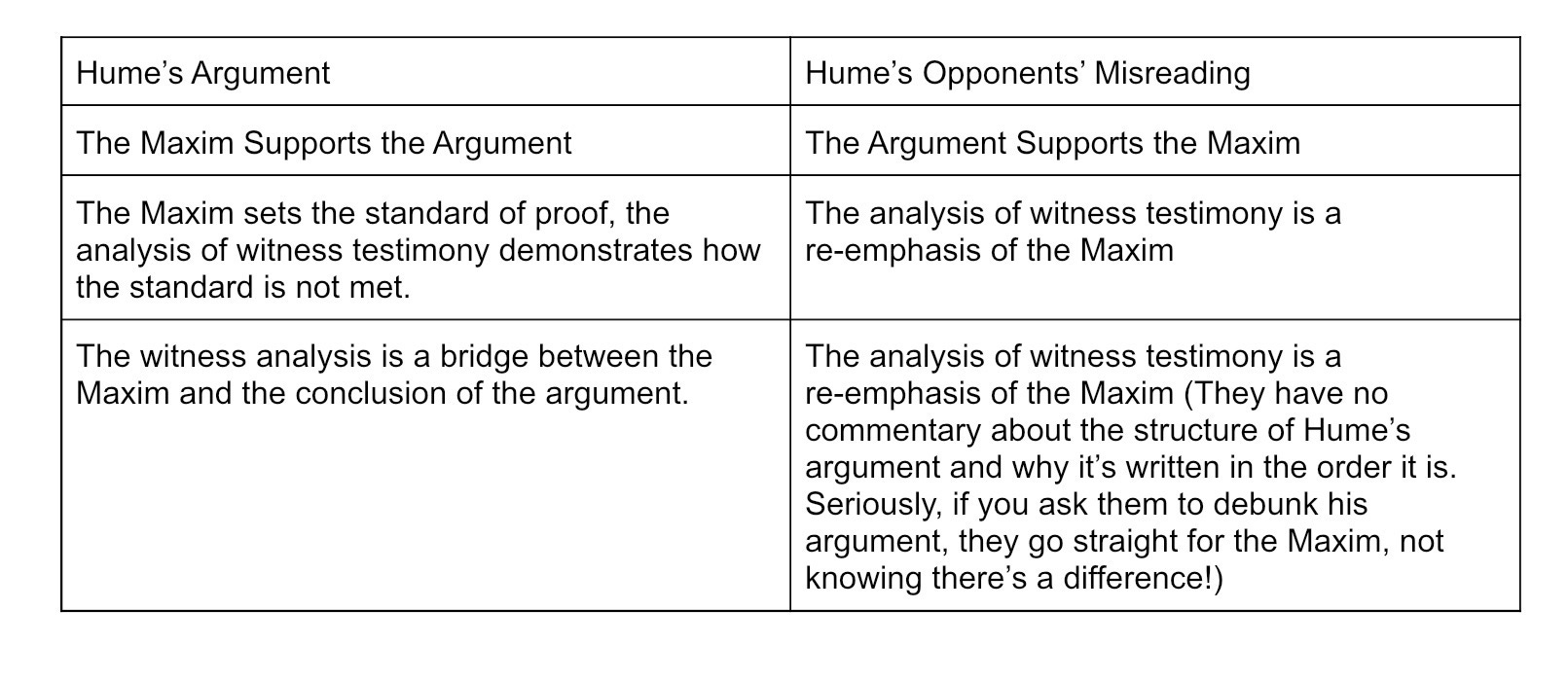
And so, Hume’s opponents get confused by the argument and maxim by thinking that the point of the argument is to support the maxim. In reality, he’s doing the opposite: he is using the maxim (as one factual component among many) to support his argument.1
What’s more, they think in the second part of the essay, where Hume undermines miraculous testimony, he’s emphasizing or doubling down on the probability calculus of the maxim. In reality, the maxim in the first part of the essay expresses the standard of evidence for miracle advocates, while the second part illustrates how miraculous testimony comes nowhere near that standard, and is in fact inferior to normal witness testimony. Here’s a helpful chart of the disagreement:
Why This Is Important
Hume’s opponents are thus confused about the structure and implications of the argument. The whole point of tying his maxim to his analysis on miraculous testimony is to demonstrate why we shouldn’t take the abundant purported evidence for miracles seriously in our primary assessment of the baseline probability of miracles.
If you’re just looking at the Maxim as something it’s not (that is, presupposing miracles don’t happen or excluding the supernatural or dismissing miracle testimony), and not also understanding the structure of the argument, you’ll also be confused. As far as I can tell, this mistake is extremely common among some very smart Christians and philosophers because misreading Hume is so normalized.
It’s important then to understand Hume’s argument and his maxim, and how they relate to one another. Because if you get them confused, you may erroneously think he’s begging the question when he’s not, and subsequently argue against a straw man.
And people don’t seem to care about the argument! Opponents don’t debunk the argument of “is it unwise to believe a miracle on testimony and therefore unwise to believe in revealed religion because that’s all the evidence we have.” No, they want to argue that miracles can conceivably happen and therefore Hume is wrong. An argument Hume doesn’t make or care about. RARGH.
Hume, re Bayes? And knowing that Bayes likely was writing in response to An Enquiry Concerning Human Understanding? He probably figured it wasn't worth further engagement.
Contra this piece https://jonathanlivengood.net/Tanner_and_Livengood_MS_Hume_and_Bayes.pdf, I reject the claim that Hume was a normativist on the issues Bayes was addressing. Rather, he was a descriptivist. (The SEP article on Hume, better than the old one it replaced several years ago. See section 5.1, beyond the descriptivist vs normativist at top. for more. https://plato.stanford.edu/entries/hume/#Mira
One big issue related to this is that, in many life issues, we can't put exact percentages of probability on priors. Ergo, we can't put exact percentages of probability on posteriors after getting new knowledge. Bayes' equation strikes me as halfway like Drake's equation in this way.
Plus, the Hume who wrote the Treatise as a Pyrrhonist probably never totally abandoned that. He may have retreated from that for "public consumption," but he never totally abandoned that. Ergo, his skepticism was likely in some way non-probabilistic all along.
The end of the Stanford section has broadly similar thoughts:
>>However, perhaps a Bayesian reading of Hume is altogether misguided and Hume subscribes to an empirical, rather than a mathematical, notion of probability found in the Baconian approach (Vanderburgh 2019). This would make Hume’s argument more plausible.<<
These have been great to read especially has I was unfortunately persuaded by headlines and casual browsing that Hume's reasoning here was "debunked" somehow (but never looked much into it)
Have you covered any theist / pro-miracle arguments against Hume that are based in a proper understanding of his maxim and conclusion? Would be curious to read those as well